
Navigating the financial landscape in India is a unique experience—one that demands both reverence for cash tradition and an appreciation for the country’s world-leading digital payment systems. India is undergoing a massive financial transformation, yet the flow of money often operates on two distinct parallel tracks: the lightning-fast digital realm and the tangible, small-cash economy.
Understanding this duality is crucial. Furthermore, mastering the local etiquette for tipping (Baksheesh) is essential to avoid cultural misunderstandings and ensure smooth, respectful interactions with service providers. This definitive guide provides every detail you need to manage your money safely, efficiently, and respectfully, from the moment you land.
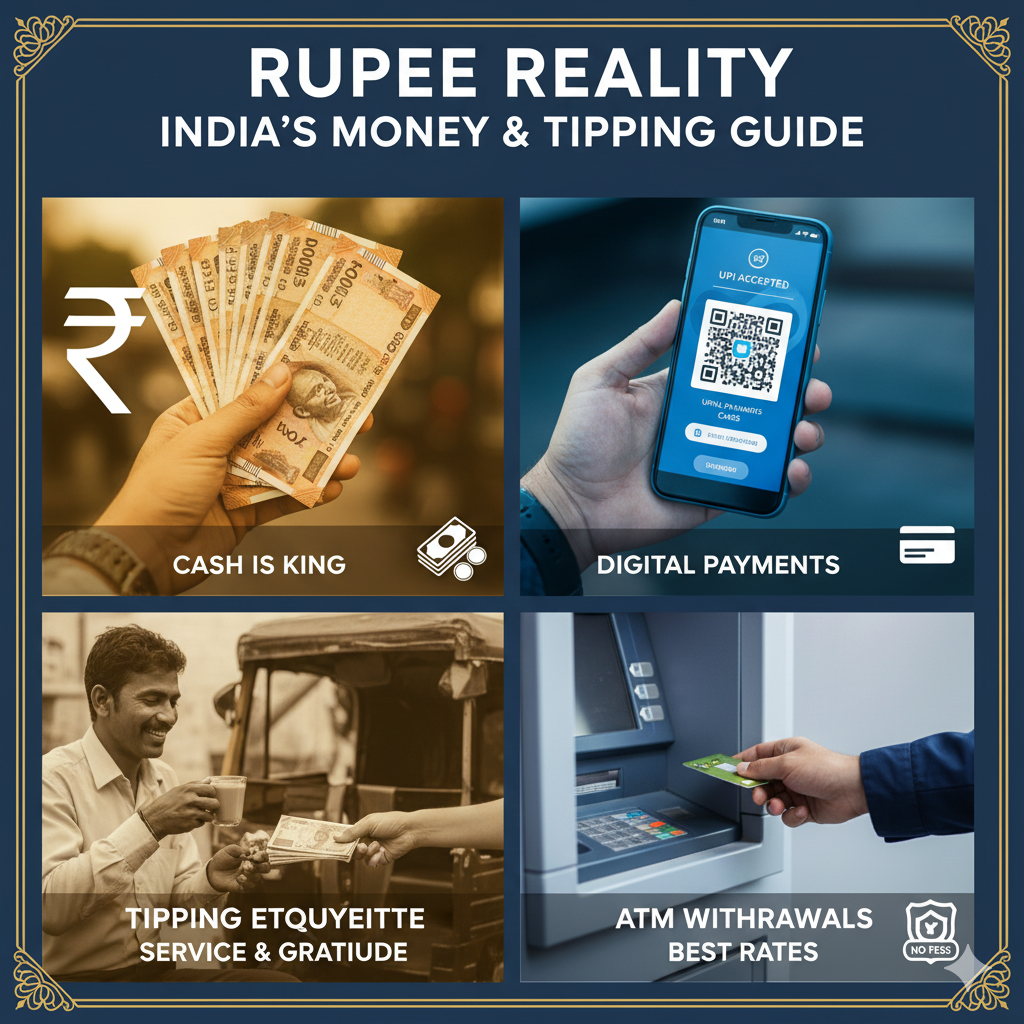
Part I: The Currency Fundamentals – Getting to Know the Rupee
The official currency of India is the Indian Rupee (₹ or INR).
1. The Anatomy of Indian Cash
- Notes: The primary denominations are ₹10, ₹20, ₹50, ₹100, ₹200, and ₹500. The ₹200 and ₹500 notes are the most common large-value bills.
- The Small Change Dilemma: The biggest mistake a traveler makes is carrying only large notes. You must prioritize carrying ₹10s, ₹20s, and ₹50s. Auto-rickshaw drivers, street vendors, and small shops will often claim they cannot provide change for a ₹500 note, forcing you to overpay.
- The Demonetization Check (2016): India replaced its old series of notes. Ensure all your ₹500 notes are light gray/stone colored and feature the Red Fort on the reverse. Old, invalid notes are illegal. Always refuse any notes that are heavily torn, taped, or dirty.
- Customs Law: It is illegal to import or export Indian Rupees. Any money you bring in must be converted upon arrival.
2. Exchange and Withdrawal Strategy
- Airport Exchange: Avoid exchanging large amounts at the airport; the rates are typically the worst. Exchange just enough (e.g., $50-100 USD) to cover your taxi and initial expenses.
- ATMs (Automated Teller Machines):This is the best method. ATMs offer the most favorable wholesale exchange rates. They are ubiquitous in all cities and large towns.
- Best Banks: Use machines operated by major national banks like State Bank of India (SBI), HDFC Bank, ICICI Bank, or Axis Bank. These are generally reliable and secure.
- Security Tip: Whenever possible, use an ATM attached to a bank during business hours. Withdraw the maximum amount allowed per transaction to minimize the impact of foreign transaction fees charged by your home bank.
- Authorized Money Changers: These offer better rates than the airport but may be subject to commissions. Always confirm the “all-inclusive” rate before handing over your money and demand a receipt.
Part II: The Parallel Economy – Digital Payments and Cards
India’s Unified Payments Interface (UPI) is a globally celebrated digital payment infrastructure that allows for instant bank-to-bank transfers via mobile apps.
1. UPI: The Digital Backbone
- How it Works: Apps like Google Pay (GPay), PhonePe, and Paytm allow users to scan a QR code at any vendor (from a large store to a small tea stall) and pay instantly.
- Ubiquity: UPI is accepted everywhere. If a vendor has a small laminated QR code stuck to their cart, they accept digital payment.
- The Foreigner Hurdle: Setting up a UPI app requires an Indian bank account and an active local Indian phone number. This makes it difficult for short-term visitors to use the system fully, though India is piloting schemes (like UPI for non-resident bank accounts) that may change this soon. Until then, rely on cash and cards.
2. Credit and Debit Card Usage
- Acceptance: Cards (Visa, Mastercard) are widely accepted at major hotels, large chain restaurants, international retail stores, and transport ticket counters in cities.
- Warning: Dynamic Currency Conversion (DCC): When paying with a foreign card, the machine will often ask if you want to be charged in INR (Rupees) or your home currency (e.g., USD, EUR). Always choose to be charged in INR. Opting for your home currency (DCC) allows the local bank to set the exchange rate, which is almost always worse than your home bank’s rate.
- Security: Always keep your card in sight during the transaction. Due to past fraud issues, many vendors still prefer manual card swipes or chip-and-PIN transactions.
Part III: The Cultural Contract – Mastering Tipping Etiquette (Baksheesh)
Tipping in India, often referred to by the more general term Baksheesh (meaning ‘a little extra’), is a gesture of appreciation for good service, rather than a fixed social requirement. However, in service industries aimed at tourists, it is an expected part of the service economy.
1. Restaurants and Food Service
- High-End/Tourist Restaurants: Tipping 7% to 10% of the bill is standard for good service. If the service was exceptional, you can go higher.
- Roadside Dhabas or Local Eateries: Tipping is optional. Rounding up the bill to the nearest ₹10 or ₹20 is sufficient.
- The Service Charge Check: Always check the bill. If a “Service Charge” (usually 5%–10%) is already included, no further tip is necessary.
2. Transportation Tipping Protocol
- Auto-Rickshaws and Local Taxis: Tipping is not strictly expected. The standard practice is to simply round up the fare to the nearest ₹10 or ₹20 (e.g., paying ₹100 for a ₹93 fare). This avoids the awkward waiting game for small change.
- Uber/Ola: Tipping is simple and easy through the app after the ride. A tip of ₹20 to ₹50 is generous, especially for a driver who was polite or helped with luggage.
- Airport/Hotel Porter: Tip ₹50 to ₹100 per bag for assistance, depending on the hotel’s class.
3. Guides and Drivers (The Big Tip)
When hiring a private guide or driver for a multi-day tour (like the Golden Triangle), tipping is standard and based on satisfaction.
- Tour Guide (Daily): ₹500 to ₹1,000 per full day, depending on their knowledge and language skills.
- Private Driver (Daily): ₹300 to ₹500 per day for safe, polite service. If the driver is with you for multiple days and is exceptional (always on time, clean car, offering cold water), ₹500 is appropriate.
4. Hotel Staff
- Housekeeping: Leave ₹100 to ₹200 per day on the bed for the cleaning staff at the end of your stay.
- Concierge/Doorman: A final tip of ₹200 to ₹500 at the end of your stay is appropriate if they provided specialized assistance.
Part IV: Money Survival and Security Tips
- Prioritize Small Bills: This cannot be overstated. Convert every large note you receive into ₹100s and ₹50s immediately. Use small notes for small vendors, and only use ₹500s at major retailers.
- ATM Security: Be aware of your surroundings when withdrawing cash. Only use machines in well-lit areas. Memorize your PIN; do not write it down.
- Check Notes and Seals: Always visually inspect currency notes for damage. When buying bottled water, ensure the cap seal is intact and breaks when opened.
- Do Not Flash Cash: Be discreet when handling money, especially in crowded markets (bazaars) or busy transit hubs. Use a money belt or secure internal pockets for your main cash reserves and passport.
- Budget for Entry Fees: Many major monuments (e.g., Taj Mahal, Red Fort, UNESCO sites) charge a significantly higher entry fee for foreigners than for locals. Factor these costs into your daily budget.
By understanding the duality of India’s cash and digital economies and practicing respectful local tipping etiquette, you ensure your journey remains smooth, financially secure, and free from common travel frustrations.