
Indian classical dance is not a mere sequence of steps and gestures; it is a profound spiritual discipline, a meticulous, centuries-old storytelling tradition, and a living prayer. Rooted in ancient Hindu philosophy and texts, these art forms represent a confluence of rhythm (tala), melody (raga), and expression (bhava), conveying epic mythological narratives, philosophical truths, and intense devotional love (bhakti).
For the traveler, witnessing a classical dance performance offers a deep window into the soul of India. Understanding the history and key characteristics of each form—from the fierce geometry of the South to the lyrical fluidity of the East—will transform the performance from a spectacle into a spiritual experience.
This definitive guide introduces the eight major classical dance forms officially recognized in India, exploring their origins, unique techniques, and the regions they represent.
Part I: The Divine Origin and Foundational Texts 📜
All classical dance forms in India trace their lineage back to the Natyashastra, an ancient Sanskrit treatise on the performing arts believed to have been compiled between 200 BCE and 200 CE.
- The Natyashastra: Attributed to the sage Bharata Muni, this text meticulously documents the principles of performance, including gesture (mudras), postures (karanas), expressions (rasas), and stage design. It posits that Natya (drama with dance and music) was created by the god Brahma as the “fifth Veda” for the enlightenment of all people.
- The Trinity of Performance: Every classical form is judged on the balance of three core components:
- Nritta: Pure dance movement; abstract, rhythmic, and decorative, focused entirely on speed and geometry.
- Nritya: Expressive dance; rhythmic movement combined with gesture and facial expression to convey a mood or meaning.
- Natya: Dramatic representation; the complete performance that includes the narrative, dialogue (usually sung by a vocalist), and expressive dance.
Part II: The Four Pillars – Forms from the South and East
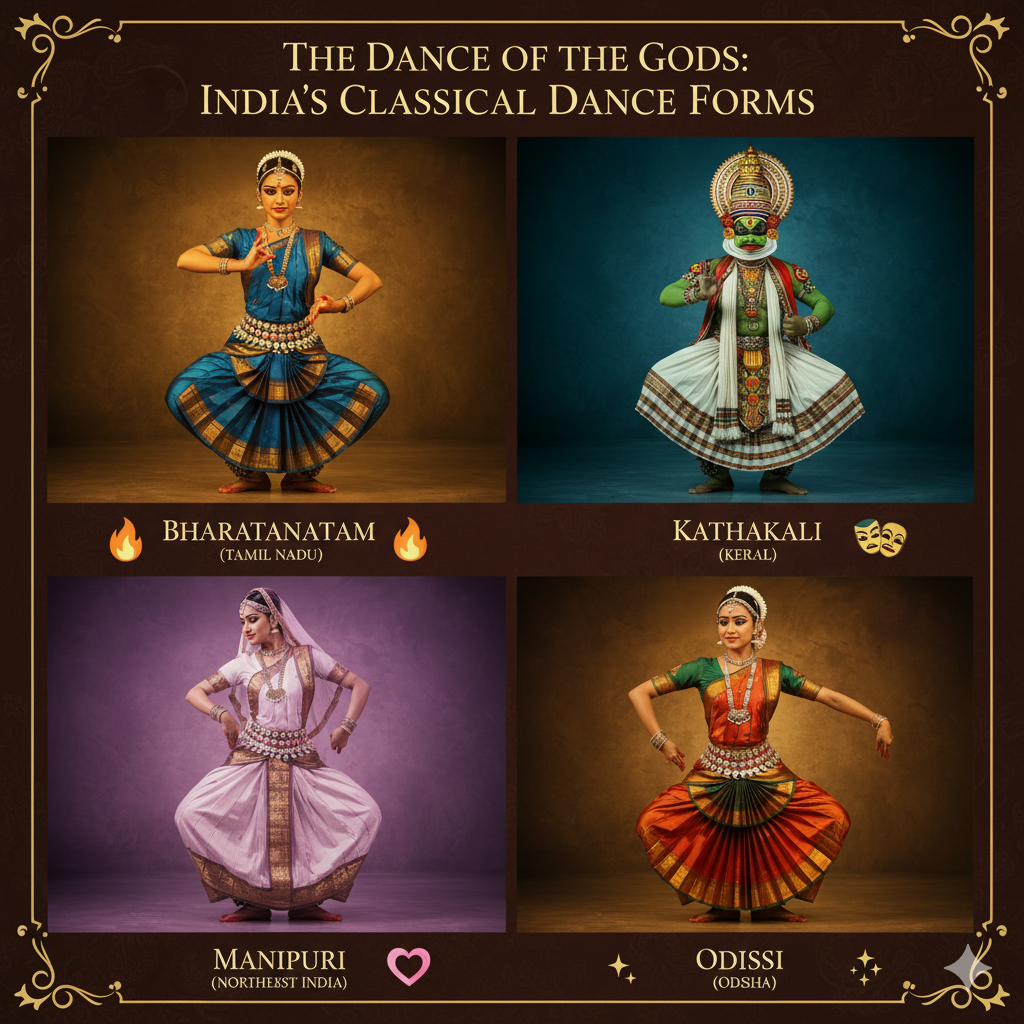
1. Bharatanatyam (Tamil Nadu): The Fire Dance 🔥
- Origin: Evolved from the temple dances (Sadir) performed by devadasis (female temple servants) in the temples of Tamil Nadu. It was codified and revived in the 20th century.
- Key Technique: Known for its firm, almost martial geometry. The most recognizable pose is the Ardhamandali (or Aramandi), a half-sit deep plié where the knees are turned out, creating a diamond shape. It emphasizes adavus (basic rhythmic units) and rapid, intricate footwork.
- Costume: Distinctive pleated, stitched silk sari that fans out like a skirt when the dancer is in the Ardhamandali pose. Dancers wear elaborate temple jewelry (usually gold) and bells (ghungroos) around their ankles.
- The Vibe: Powerful, direct, dynamic, and devotional. It primarily conveys Hindu mythological stories, focusing on the strong emotions (bhava) of the characters.
2. Kathakali (Kerala): The Narrative Drama 🎭
- Origin: A spectacular classical dance-drama from Kerala, developed from ancient folk and ritual theatre forms like Koodiyattam.
- Key Technique: An extremely difficult form focusing on elaborate mudras (hand gestures, of which there are 24 major types) and intense control over facial muscles to portray the nine rasas (emotions) dramatically. Dancers never speak; the story is narrated by vocalists.
- Costume: Massive, highly stylized, colorful makeup (taking hours to apply), towering headgear (kiritam), and voluminous white pleated skirts. Colors signify character traits (e.g., green for heroes/gods, red for evil/demonic).
- The Vibe: Grand, heroic, operatic, and mythological. Traditionally performed by male dancers (who also play female roles), telling epic stories from the Mahabharata and Ramayana.
3. Kuchipudi (Andhra Pradesh): The Theatrical Soliloquy 💡
- Origin: A dance-drama tradition from the village of Kuchipudi in Andhra Pradesh. It originated as a performance by a troupe of male Brahmin dancers.
- Key Technique: It blends pure dance and expression with theatrical elements, often including singing, spoken dialogue, and fast, rhythmic footwork. A unique feature is the Tarangam, where the dancer performs complex footwork while balancing on the rim of a brass plate.
- Costume: Similar to Bharatanatyam but generally less elaborate, with a single decorative plate at the waist.
- The Vibe: Lyrical, playful, and theatrical. Often portrays lighter mythological stories, with dancers engaging the audience directly through humor or dramatic monologue.
4. Odissi (Odisha): The Sculpture Come Alive ✨
- Origin: Often cited as the oldest living classical dance form, with postures depicted in the 1st century BCE caves of Udayagiri and the temples of Konark and Puri. Evolved from temple dance (Mahari tradition).
- Key Technique: Distinguished by the Tribhanga (triple-bend pose, where the head, torso, and hips bend in three different directions) and the Chauka (a square, stable pose symbolizing Lord Jagannath). The movements are incredibly fluid, sensuous, and lyrical, compared to the waves of the ocean.
- Costume: A distinctive pleated silk sari (often in vibrant colors) and elaborate silver temple jewelry (a hallmark of the region, worn instead of gold).
- The Vibe: Soft, lyrical, and devotional, heavily focused on the love stories of Radha and Krishna and the worship of Lord Jagannath.
Part III: The Other Four – Regional Diversity and Unique Styles
5. Kathak (North India): The Storyteller’s Spin 🌀
- Origin: Evolved from Kathakars (traveling bards or storytellers) in North India, who used gesture and song to narrate tales. It later gained courtly elegance under Mughal influence, incorporating Persian court mannerisms.
- Key Technique: The hallmark is the intricate, rhythmic Tatkar (footwork), executed in perfect time with the tabla or pakhawaj. The dancer wears hundreds of small bells (ghungroos) that emphasize the rhythmic cycles. It is characterized by rapid, graceful Chakkar (pirouettes/spins).
- Costume: The style varies: Hindu style uses a simple lehnga (long flowing skirt) and bodice, while the Mughal-influenced style uses an Anarkali dress or churidar-kurta.
- The Vibe: Elegant, narrative, rhythmic, and technically brilliant. Focuses heavily on the jugalbandi (rhythmic dialogue) between the dancer and the musician.
6. Manipuri (Manipur): The Blissful Movement 💖
- Origin: Rooted in the ritual and folk traditions of the Manipur valley in Northeast India. It is intrinsically linked to the worship of Lord Krishna and the Vaishnavite tradition.
- Key Technique: Unlike all other forms, Manipuri uses very soft, gentle, and flowing body movements with an emphasis on gliding and curves, without the sharp hip or knee deflections common elsewhere. The footwork is subtle and flat-footed. The entire focus is on Bhakti (devotion).
- Costume: The female dancer wears a beautifully adorned, stiff, cylindrical skirt called the Kumil (often decorated with mirrors), and light translucent veils. The male dancer wears a simple dhoti.
- The Vibe: Serene, devotional, and graceful, focusing almost exclusively on the Ras Lila (the divine dance of Radha and Krishna).
7. Sattriya (Assam): The Monastic Tradition 🙏
- Origin: Developed in the 15th century by the Vaishnavite reformer and saint Srimanta Sankardeva as a means of propagating the faith in Assam. It was historically performed exclusively by male monks (bhokots) in monasteries (sattras).
- Key Technique: Combines elements of Nritta and Nritya with special emphasis on dynamic movement, powerful jumps, and distinct use of the torso and hand gestures. It often involves instruments and unique Assamese rhythms.
- Costume: Traditionally uses a white or yellow silk dhoti and chadar. Modern performances often use regional silk (pat or muga) with local jewelry.
- The Vibe: Austere, dramatic, and intensely devotional, focusing on the exploits of Lord Vishnu.
8. Mohiniyattam (Kerala): The Dance of the Enchantress 🦢
- Origin: A solo feminine dance form from Kerala, meaning “The Dance of the Enchantress.” It tells the story of Lord Vishnu’s feminine incarnation, Mohini.
- Key Technique: Distinguished by its gentle, swaying movements (Lasyam), which are highly fluid and graceful, drawing inspiration from the motion of the palm trees and the waves of the Arabian Sea. The posture is characterized by the smooth, undulating movement of the hips and torso (Ati Bhanga).
- Costume: Simple, elegant white or off-white sari with gold borders, and minimal jewelry compared to Kathakali. The hair is traditionally gathered in a large bun on the side of the head.
- The Vibe: Ethereal, gentle, seductive, and lyrical. It focuses on Sringara Rasa (the emotion of love) and devotion to the Hindu deities.
Part IV: The Traveler’s Guide to Watching a Performance 👏
- Seek Authentic Venues: Look beyond tourist performances. The best places to see authentic classical dance are:
- National Festivals: Major cities host annual classical dance festivals (e.g., Khajuraho Dance Festival, Konark Dance Festival).
- Academies: Cultural centers like the Sangeet Natak Akademi in Delhi or the Kalakshetra in Chennai often host high-quality performances.
- Preparation: Read the performance synopsis beforehand. Understanding the mythological story being narrated (Natya) will dramatically enhance your appreciation of the dancer’s expressive technique (Nritya).
- Appreciate the Orchestra: The live orchestra—which includes vocalists, drummers (mridangam/tabla), and accompanying string/wind instruments—is integral to the art form. The dancer is in constant conversation with the rhythmic cycles (tala) set by the drummer.
By recognizing the distinct styles, costumes, and mythological roots of these eight classical forms, you move past mere observation and begin to connect with the profound cultural heritage preserved in every pose and rhythmic footfall.