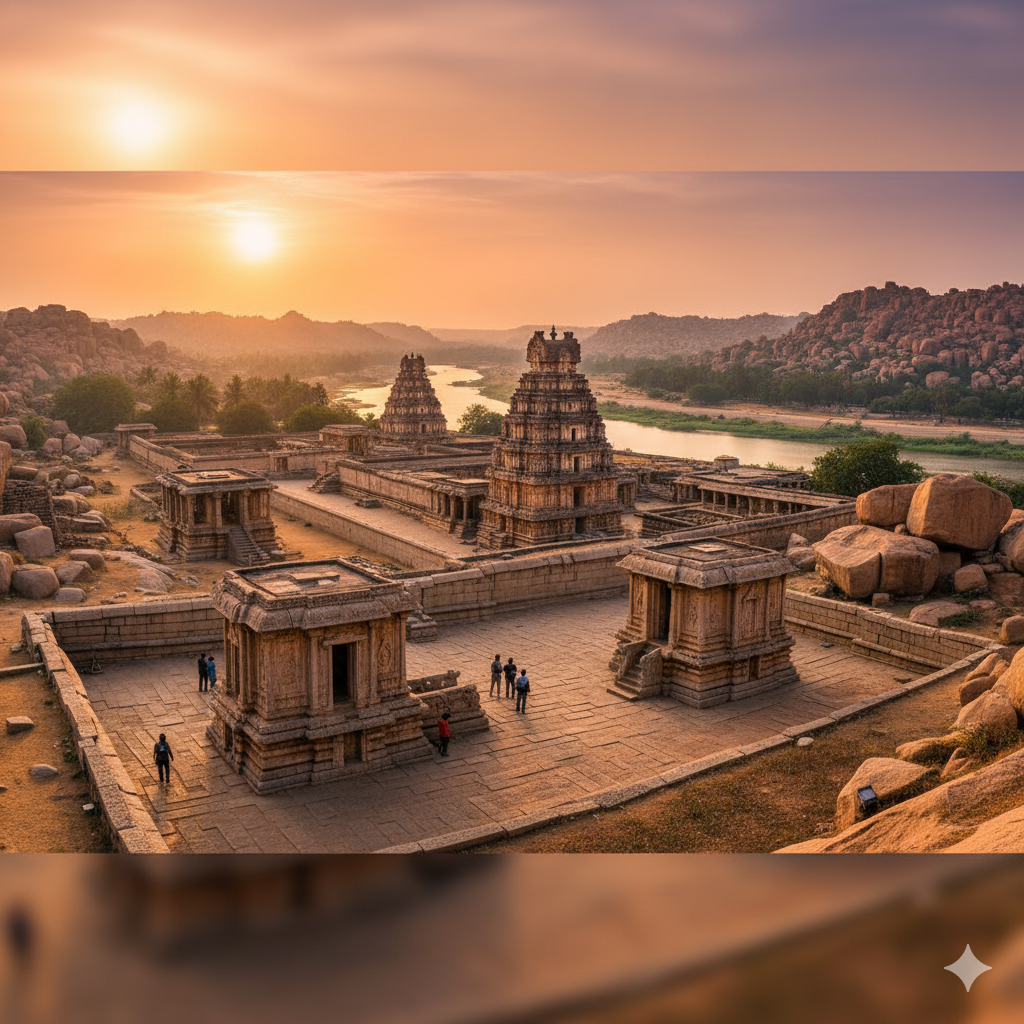
Imagine a landscape where colossal boulders are stacked like forgotten giants' toys, where an ancient river gently carves its path through a tapestry of history, and where the remnants of a glorious empire stand testament to a bygone era. Welcome to Hampi, Karnataka – a UNESCO World Heritage site that isn't just a destination, but an immersive journey into the heart of India's past.
The 14th-century capital of the mighty Vijayanagara Empire, Hampi whispers tales of grandeur, devotion, and remarkable architectural prowess from every stone. For history enthusiasts, photographers, and seekers of the extraordinary, Hampi offers an experience that is both profoundly moving and visually breathtaking. Prepare to be transported to a time when gold was traded in the streets and kings commanded vast armies.
The Historical Tapestry: The Rise and Fall of Vijayanagara
To truly appreciate Hampi, one must understand the context. The city was the heart of the Vijayanagara Empire, which flourished from the 14th to the 16th century. It was one of the largest and wealthiest empires of its time, protecting South Indian Hindu culture from Sultanate expansion.
The city, known then as Vijayanagara (City of Victory), reached its zenith under the rule of Krishnadevaraya (1509–1529 CE). Foreign travelers like Domingos Paes and Fernão Nunes described it as being as grand as Rome, filled with diamonds, pearls, and bustling markets. Its prosperity allowed for the patronage of arts, literature, and, most importantly for us today, magnificent temple architecture.
The glory ended tragically in 1565 with the Battle of Talikota, where the combined armies of the Deccan Sultanates routed the Vijayanagara forces. The city was subsequently looted, dismantled, and virtually abandoned, leaving behind the spectacular ruins we explore today. This tragic history is what makes walking through Hampi so poignant—you are literally treading upon the remains of a spectacular civilization.
🌄 The Surreal Landscape: Where Nature's Art Meets Human Genius
Before you even step foot into a temple, Hampi's unique geological formation will seize your imagination. Gigantic, smooth, reddish-brown boulders are strewn across the hills and valleys as far as the eye can see, seemingly defying gravity. This striking terrain is believed to be older than the Himalayas. Local mythology ties this landscape to the Ramayana, suggesting that Hampi is located in the ancient kingdom of Kishkindha, home of the monkey god Hanuman and his army.
- The Tungabhadra River: This ancient river flows through the site, giving life to the palm groves and banana plantations, and separating the main temple complexes from the mythological sites on the north bank (often called the 'Anegundi side').
- Anjanadri Hill: Located on the north bank, this hill is universally believed to be the birthplace of Hanuman. Climbing the 575 steps to the top is rewarding not only for the small temple but also for the unrivaled, sweeping views of the entire Hampi valley at sunrise.
🏛️ The Sacred Centre: Architectural Masterpieces
The main cluster of religious structures is the soul of Hampi. Plan to spend a full day exploring these complexes, where intricate carvings depict Hindu mythology, royal life, and scenes of warfare.
1. The Virupaksha Temple
This is the heart of Hampi, and the only temple complex that has remained in continuous worship since its construction. It is a powerful, living religious site.
- The Gopuram: The temple's towering entrance gate stands at nearly 50 meters (165 feet) high, casting a grand shadow over the Hampi Bazaar. Its multiple tiers are covered with stucco figures depicting gods, goddesses, and mythical creatures.
- The Pin Hole Camera Effect: In a dark room within the temple's smaller shrine complex, a small hole acts as a camera obscura, projecting an inverted image of the main gopuram onto the opposite wall. It's an incredible example of ancient scientific knowledge.
- Lakshmi, the Temple Elephant: Start your day early and you might catch the morning bath ritual of Lakshmi, the temple's revered elephant, in the river, which is a wonderful cultural sight.
2. The Vittala Temple Complex
Considered the pinnacle of Vijayanagara architectural style, the Vittala Temple is the most famous and artistically significant ruin in Hampi.
- The Stone Chariot: The undisputed centerpiece. This magnificent shrine, actually made of stone, is sculpted to look like a colossal wooden chariot. It has become an iconic symbol not just of Hampi, but of Indian heritage itself. Though it appears to be a single structure, it was carved from several massive granite blocks.
- The Musical Pillars (Ranga Mandapa): This famous pavilion is home to fifty-six carved pillars. When gently tapped (please be respectful and follow any guide instructions), they emit distinct musical notes—a testament to the acoustical brilliance and mastery of the ancient sculptors.
👑 The Royal Centre: Power and Governance
Located a few kilometers south of the Sacred Centre, this area housed the administrative buildings, military quarters, and residences of the royal family. The architecture here shows a beautiful blend of Hindu and Islamic styles, reflecting the cultural exchange of the era.
- Lotus Mahal: Perhaps the most elegant structure in Hampi. It served as a recreational palace for the royal ladies. The symmetrical structure, with its arched windows and multi-lobed domes, was designed to keep the interiors cool, using a sophisticated, ancient form of air conditioning achieved through natural ventilation.
- Elephant Stables: This grand building, featuring eleven high-domed chambers, once housed the royal elephants of the Vijayanagara army. Each stable has a unique dome style—some in the Hindu style, others resembling Islamic architecture, again demonstrating the empire's cosmopolitan influence.
- Mahanavami Dibba: This massive, three-tiered stone platform served as a viewing area for the King and royal family during festivals, particularly the Mahanavami (or Dussehra) celebration. Its sides are covered with exquisite carvings depicting royal processions, hunting scenes, and dancing girls, giving us a vivid glimpse into the courtly life of the time.
- Stepped Tank (Pushkarani): While several stepped tanks exist, the one near the Royal Centre is the most famous. Used for religious rituals, it features a perfect geometric, tiered design leading down to the water, showcasing an incredible mastery of hydro-engineering.
🚶♀️ The Lost Art of Exploration: How to Spend 72 Hours in Hampi
Hampi is sprawling. While it can be "seen" in one long day, to truly experience it, we recommend a three-day itinerary.
Day 1: The Sacred Centre and Sunset
Focus on the main attractions.
- Morning: Virupaksha Temple, explore the Hampi Bazaar, and walk through the Achyutaraya Temple complex.
- Afternoon: Visit the famous Vittala Temple (allow 2-3 hours here).
- Evening: Climb Hemakuta Hill for the ultimate sunset view over the Virupaksha gopuram.
Day 2: The Royal Core and History
Explore the administrative and military complexes.
- Morning: Rent a bicycle or scooter. Visit the Lotus Mahal, Elephant Stables, Mahanavami Dibba, and Queen’s Bath.
- Afternoon: Visit the Zenana Enclosure and the massive Underground Shiva Temple.
- Evening: Explore the archaeological museum in the nearby town of Kamalapura to see actual artifacts recovered from the site.
Day 3: The Mythological North Bank (Anegundi)
Cross the Tungabhadra River for a different flavor of Hampi.
- Morning: Take a coracle across the river (or use the main bridge/ferry). Climb Anjanadri Hill to visit the Hanuman Temple (allow 2 hours for the climb and descent).
- Afternoon: Visit the small, charming village of Anegundi, the older "capital" of Kishkindha. See the Pampa Sarovar and the beautiful Lakshmi Temple.
- Evening: Relax by the river or enjoy a local meal in the Hampi Bazaar area.
🛵 Practical Travel Logistics and Tips
Getting Around
- Bicycle/Scooter: The best way to cover the distance (6-8 km) between the Sacred and Royal centres is by renting a cycle (₹100–200/day) or a scooter (₹300–400/day).
- Auto-rickshaws: Auto drivers offer full-day tours. This is a great option if you prefer a guided experience, but confirm the price and itinerary before you start.
- On Foot: Essential for the inner temple areas and for climbing the hills. Wear comfortable walking shoes!
Best Time to Visit
- October to February: This is the ideal window. The weather is pleasant, typically ranging from 15^\circC to 30^\circC.
- March to June: Avoid these months if possible. Temperatures soar past 40^\circC, making daytime exploration challenging.
Accommodation and Cuisine
- Where to Stay: Accommodation is available primarily in the Hampi Bazaar area or on the quieter north bank (Anegundi). Larger hotels are located in the nearby town of Hospet.
- Cuisine: Hampi is a predominantly vegetarian destination due to its religious significance. You will find delicious and affordable South Indian thalis, dosas, and idlis. The traveler cafes (especially on the north bank) also offer excellent international options like pancakes and Israeli food.
Essential Tips
- Hydration is Key: Carry ample water, especially during the middle of the day. The heat, even in winter, can be intense when walking among the stones.
- Respect the Sites: Remember that temples like Virupaksha are active places of worship. Dress modestly, covering shoulders and knees, and always remove your footwear before entering temples.
- Hire a Guide: For sites like the Vittala Temple and the Royal Enclosure, hiring an approved local guide is highly recommended. Their narratives on the architecture, history, and mythology are invaluable and truly bring the ruins to life.
Hampi offers an unparalleled journey into a forgotten world. It challenges you with its heat and demands your attention with its history, but rewards you with memories that will last a lifetime. Pack your camera, your curiosity, and your sturdy shoes, and prepare to be enchanted by the echoes of Vijayanagara.